Read this when
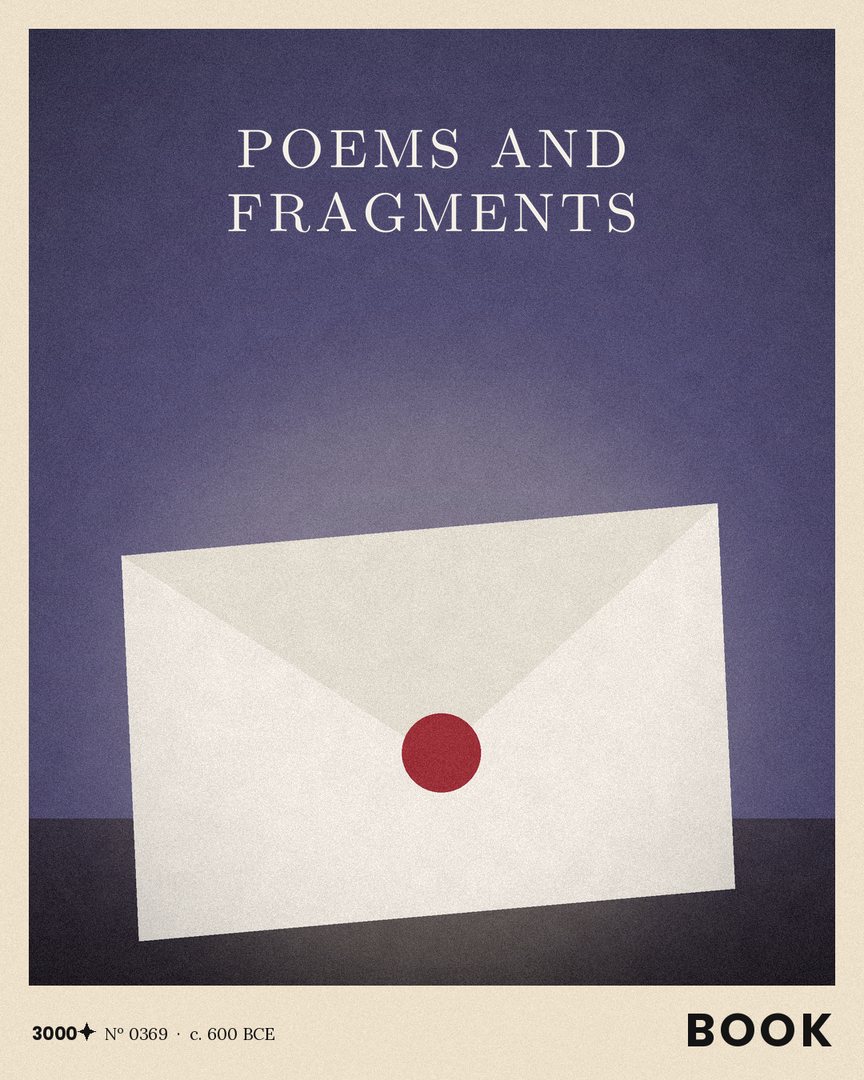
Poems and Fragments
Can't talk, face on fire, ears ringing because your crush laughed at someone else's joke? Sappho described it in 600 BCE. You're not broken, you're human. 🔥
Who it's for
Fragment 31 is one of the most exact descriptions in literature of what intense desire and jealousy do to a body: a tongue that breaks, thin fire under the skin, eyes that can't see, ringing ears, sweat and trembling.
Feelings it meets
What it is
The surviving poetry of Sappho, the ancient Greek lyric poet from Lesbos (c. 630-570 BCE), of which only about 650 lines remain, mostly as fragments preserved in quotations and papyri; Anne Carson's translation is published as If Not, Winter: Fragments of Sappho (2002). The poems deal with love, longing, family and the gods.
Where to find it
Older translations (e.g., H. T. Wharton's 'Sappho') are public domain and free on Project Gutenberg. Anne Carson's 'If Not, Winter' (2002) is in print and in libraries; it predates the 2004 papyrus fi.
Before you start
Heads up: A wish to be dead, from grief.
Age: Ages 14+
Love looks not with the eyes, but with the mind; And therefore is wing'd Cupid painted blind.William Shakespeare, A Midsummer Night's Dream, Act 1, Scene 1